
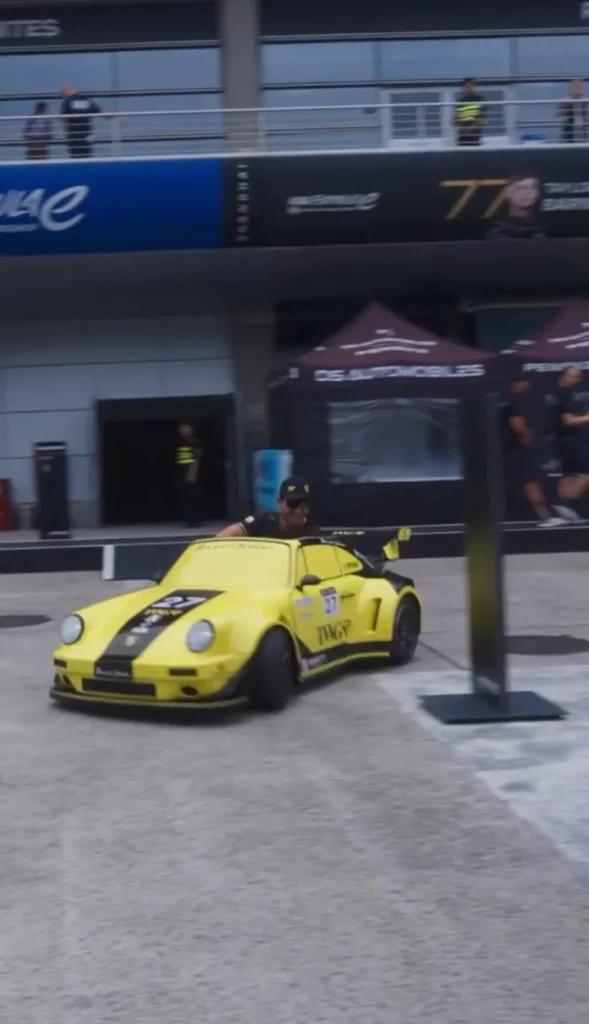
There's a moment every parent remembers: the helmet goes on, the seat slides forward, and a teenager grips the wheel of a half-scale legend for the very first time. Get the next ten minutes right and you'll create a confident, careful driver. You'll also stay the fastest driver in the house. For now.
Our electric and gas replica go karts are built for riders aged 12 to 60. Here's how to set up the first drive so it's thrilling for them and relaxing for you.
Step zero: do they fit?
The cockpit fits drivers from roughly 5'0" to 6'4". For younger teens, height usually matters more than age. A driver needs to sit properly, reach the pedals comfortably and see clearly over the bodywork. Not sure? Tell us the rider's height when you request your build and we'll advise.
Pick the learner-friendly model
For new and younger drivers we recommend the Standard (3000W). With a top speed of up to 45 mph and smooth, predictable power off the line, it's the easiest kart to learn on. The Performance and 4-Cylinder models reach up to 65 mph, which is a lot of speed to manage on day one.
Your two secret weapons
The speed limiter (kids mode) caps top speed so new drivers can master steering and braking before the full power arrives. Think of it as a learner's permit that you control. Lift it bit by bit as confidence grows.
The remote parental control lets an adult slow or stop the kart from a distance with a handheld controller. Families with big properties tell us it's the option they'd choose again, because you can supervise without sprinting after a go kart.
Both extras are optional and priced in your quote. Ask for them when you request your build.
Gear up before the first lap
• A properly fitted helmet, every drive, every driver
• Closed shoes. No sandals, no bare feet on the pedals.
• Fitted clothing, with nothing loose to snag
• Eye protection if the helmet has no visor
Walk the course like a race engineer
Before anyone drives, walk the route and look for:
• Gravel, sand, wet leaves or puddles
• Slopes, drop-offs and soft edges
• Blind corners, gates, posts and parked cars
• Pets, toys and anything left lying around
Start on a flat, smooth, paved area with plenty of run-off and zero traffic. Keep spectators well back, behind something solid if you can.
The three-session training plan
Session 1: get comfortable (limiter on, slowest setting)
• Sit-in first: seat, pedals, steering and where everything is
• Slow laps of a simple loop
• Smooth starts and gentle stops, over and over
• Finish while it's still fun, before concentration fades
Session 2: build control (limiter still on)
• Braking to a marked stop line from a little more speed
• Wide, smooth turns in both directions
• Practise the remote, so the driver knows exactly what it feels like when you slow the kart
Session 3: build confidence (limiter on, or lifted slightly)
• A slightly longer route with gentle bends
• Look ahead, not at the front of the car
• Raise the limit only when braking and steering are smooth every single time
House rules worth shaking hands on
1. An adult is present for every drive.
2. The helmet goes on before the kart moves.
3. One driver at a time, and no passengers.
4. Private property only. Never public roads or sidewalks.
5. The adult decides when the limit goes up.
6. If the remote stops the kart, the driver stops. No debate.
After the drive
Park up, switch off and let the kart cool before charging with the supplied charger. Our battery care guide covers the full routine.
Quick FAQ
What age can drive it?
Riders aged 12 to 60 who fit the cockpit (roughly 5'0" to 6'4") and are supervised while learning.
Can the speed limit be raised later?
Yes. The limiter can be lifted as the driver gains confidence.
Is it road legal?
No. All of our karts are for private property only.
Tell us the driver's age, height and where you'll drive, and we'll suggest a setup that makes the first drive unforgettable, for all the right reasons.
Add kids mode to your build →